
GPT-6 for engineering: Astra, Sol or Luna?
Updated 24 September 2026
Source-checked: 24 September 2026.

GPT-6 is a family, so an engineering team has a selection problem rather than a single upgrade button. Start with one clearly defined job, compare the candidates against the same evidence, and choose the model that delivers an acceptable result at an acceptable total cost. The biggest model does not automatically belong in every step.
What is different about the GPT-6 family?
The current official family comprises Astra, Sol and Luna. OpenAI positions Astra for its highest capability, Sol for demanding reasoning and Luna for efficient repeatable work at scale. Those are useful starting points for a shortlist, not measurements of performance on your product. The official GPT-6 guidance also describes asynchronous tool calls, mid-turn steering and changes to reasoning effort during a conversation.
For an engineering team, the interesting question is whether these capabilities make the workflow easier to supervise. Can a user correct a requirement while work continues? Can independent evidence be collected without blocking everything else? Can the application show what is complete, what failed and what still needs review? These questions are more useful than asking whether a model sounds impressive.
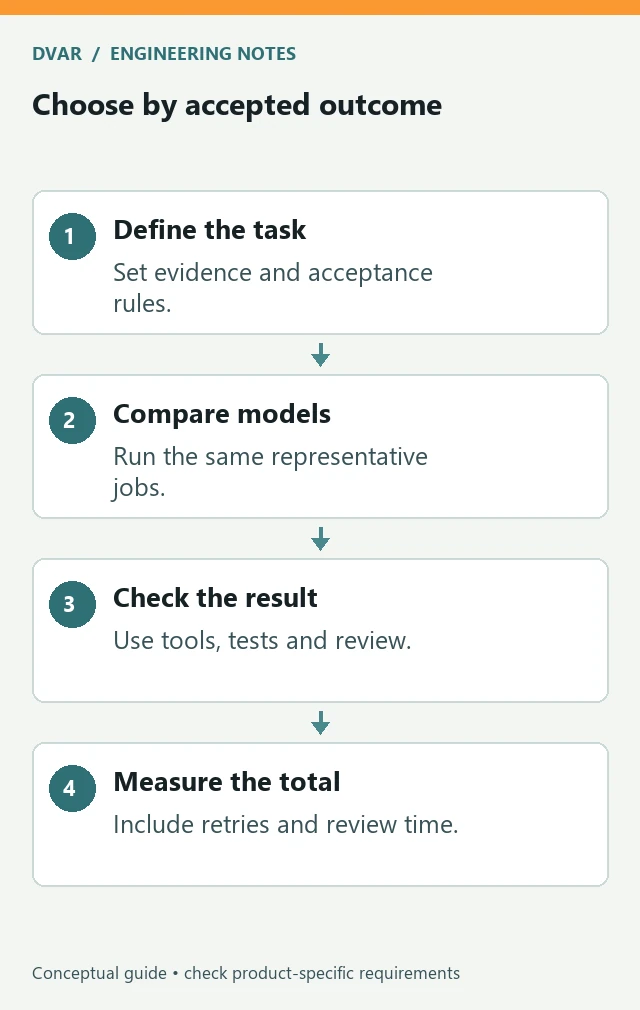
A practical starting point for Astra, Sol and Luna
- Astra: include it in the comparison for difficult investigations involving several interacting requirements or tools. A possible trial is analysing a failure report against a change history and proposing a testable explanation.
- Sol: compare it on substantial but bounded development tasks, such as producing a draft test specification from a well-defined interface contract.
- Luna: assess it for repeated, tightly framed work, such as organising documentation records or preparing consistent summaries for review.
These are proposed evaluation tasks, not demonstrated results. Keep the input documents, allowed tools and acceptance rubric identical. If a smaller candidate misses an important condition, investigate whether the task needs better context, a deterministic check or a different model. Simply asking for a longer answer can hide the original problem.
Tool calling still needs an engineered application
GPT-6 asynchronous tool calling allows the model to continue independent work while a tool is running. Your application still executes the tool and manages the background job; execution is not transferred to the model provider. Results must be associated with the original call identifier. See the async tool documentation.
Consider an illustrative firmware investigation. A read-only tool fetches the relevant test log while a separate tool retrieves the interface specification. The application can show both as pending. Once the results arrive, the model prepares a proposed investigation plan. A failed lookup should remain visibly failed, rather than being replaced by a plausible description of what the missing log might have contained.
Keep tools narrow: retrieve an approved document, run a named test suite in an isolated environment, or read a recorded measurement. Give jobs timeouts and explicit terminal states. Before allowing any physical test or firmware flashing, enforce permissions, target identity and equipment limits in the application. Model-generated text should not bypass those controls.
Structured output is an interface, not a test result
Structured Outputs can constrain a response to a supplied schema. That is useful when a proposed test needs consistent fields such as requirement ID, stimulus, expected result and evidence reference. Integrations must also handle refusals and incomplete responses. The Structured Outputs guide explains the supported schema approach and response handling.
An orderly record can still describe an unsuitable test. Check that the cited requirement exists, that the stimulus can be produced safely and that the expected result comes from an approved source. Separate a proposed test, an executed test and an accepted result in both the database and the interface. This makes it harder for a persuasive draft to be mistaken for completed verification.
Compare the cost of accepted work
Build a small evaluation set from representative, authorised material: straightforward cases, ambiguous cases, missing information and contradictory requirements. Define what counts as acceptable before reviewing the answers. Record incorrect conclusions as well as missing citations, unnecessary tool calls and cases needing manual correction.
Track total API spend, tool execution cost, waiting time and reviewer time. Divide workflow spend by the number of outputs that actually pass your acceptance criteria. Keep the quality failure rate alongside that figure: an inexpensive accepted answer does not compensate for an unacceptable rate of dangerous or misleading answers elsewhere. Retest after changing prompts, model settings or source material.
Before connecting confidential project data
Decide what may leave the organisation before connecting repositories or test records. Remove credentials and unnecessary customer identifiers, limit retrieval to approved documents, and check the specific service contract and retention configuration. A model name alone does not establish an acceptable data-processing arrangement.
- Define one bounded task and its acceptance criteria.
- Compare candidate models using the same inputs and tools.
- Keep proposed conclusions separate from measured evidence.
- Test missing data, tool failures and interrupted jobs.
- Record model settings and repeat the evaluation after changes.
For product teams, the opportunity is a better-connected engineering process: useful assistance with clear evidence and controlled actions. Explore DVAR’s AI and ML integration and embedded software services to discuss a workflow around your product’s requirements.