
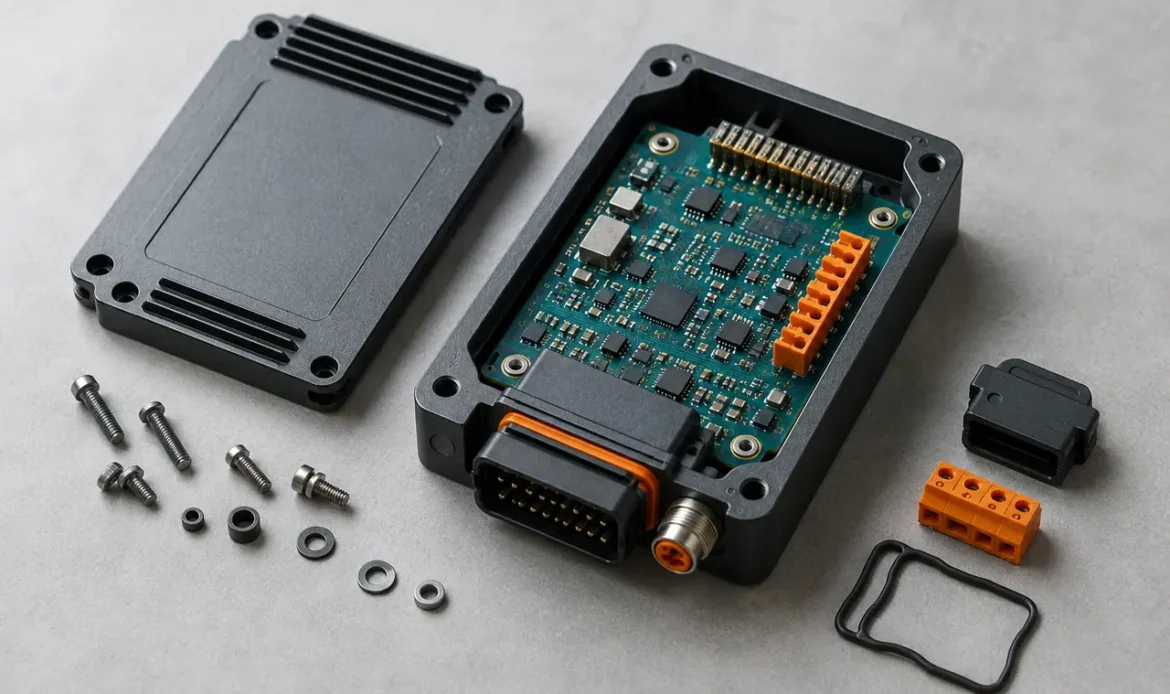
This concept explores the engineering decisions behind a compact industrial sensing module. It is a planning example, not a completed customer product. The visual is generated and does not specify a production-ready design.
The starting requirement
Imagine a team developing a module that gathers measurements from industrial equipment and passes useful information to another system. Before selecting components, the team needs to define what is measured, where the device operates, how it is powered and how information leaves the module.
Define the interfaces first
The sensing input, power connection, communications interface and enclosure are linked decisions. A useful specification records the expected operating conditions, mounting constraints, connector requirements and how the product should behave when inputs or power are interrupted.
The next decision is an architecture review: identify the functional blocks, the responsibilities of hardware and firmware, and which assumptions need a prototype or experiment before detailed design.
Connect electronics and firmware
A hardware work package would consider component selection, circuit design, PCB layout and practical access for development and test. Firmware work would define device interfaces, acquisition behaviour, configuration and communication handling. Neither package should assume the other will resolve an unspecified boundary.
A shared interface document helps make integration testable. It can record signals, data formats, expected states and how faults are reported. The exact platform, interfaces and implementation would be selected for the actual requirement.
Plan verification alongside development
A verification plan connects each important requirement to a review, analysis or test. Early bench checks establish whether the major architecture assumptions hold. Later integration checks examine the assembled system against agreed acceptance criteria.
Test access, programming and calibration need consideration before the enclosure and PCB are finalised. The concept image illustrates the relationship between these parts; it is not evidence of environmental protection, certification or measured performance.
Prepare a useful handover
The intended handover could include controlled design files, a bill of materials, firmware build instructions, interface definitions, prototype records and verification results. Manufacturing information and acceptance criteria would be agreed for the intended build stage.
DVAR’s product development, electronic hardware and embedded software services connect these work packages. A project conversation would establish the actual scope, constraints and deliverables.