
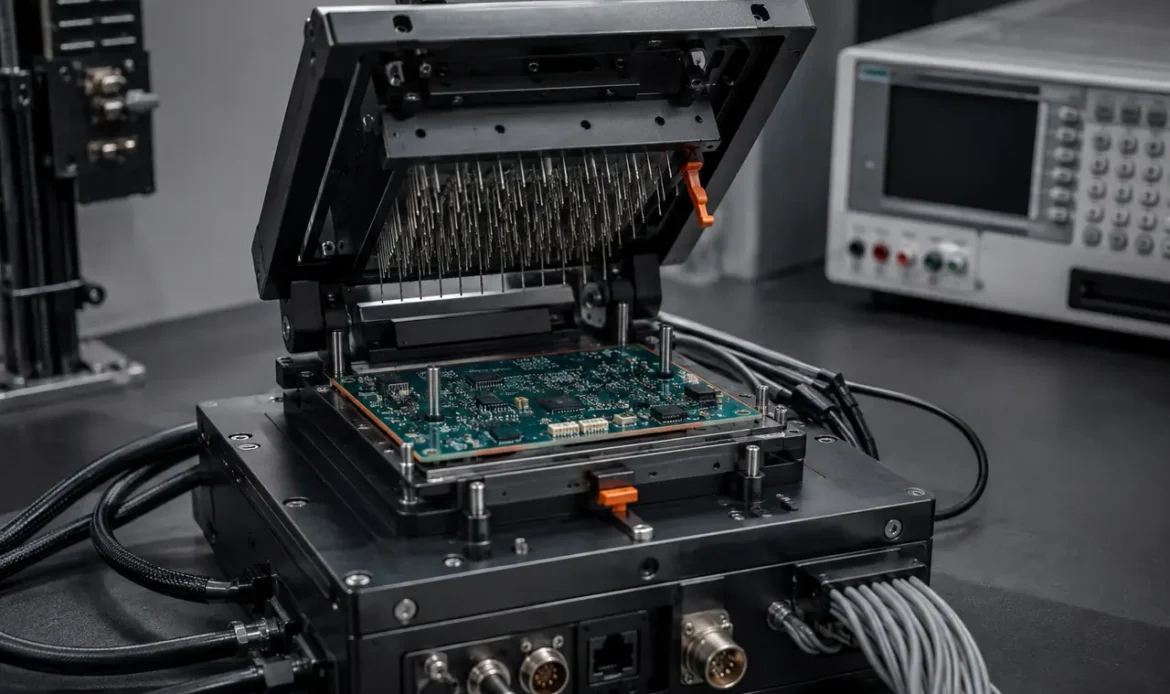
This illustrative study considers a test system for an electronic assembly. It describes a possible engineering approach rather than a commissioned customer project. The generated fixture visual is not a validated equipment design.
Understand the existing checks
Consider a team moving an assembly from development into a controlled pilot build. Engineers can check an individual unit on a bench, but production needs an agreed sequence, consistent connections and a record of what was tested.
The starting point is a review of product requirements, expected faults, available test interfaces and the information that should be recorded. Automating an unclear test does not make its acceptance criteria clearer.
Define coverage and acceptance
The test specification would identify which functions are checked, what stimulus is required and which measurements support each decision. Limits should come from the product requirement and verification work, with uncertainty and repeatability considered where they affect the result.
Development diagnostics, production screening and full design verification have different jobs. A production sequence should make its coverage and limitations explicit.
Design the fixture around the assembly
Mechanical location, connector access, harness routing and operator handling influence fixture reliability. Probe access and replacement needs should be considered alongside the board design. The selected instrumentation depends on the actual signals, loads and interfaces involved.
A fixture concept also needs a maintenance approach. Wear items, connection checks and a method for confirming the test station’s condition should be defined before handover.
Make the workflow clear
The operator needs clear instructions for loading a unit, starting a sequence and responding to an incomplete or failed test. Product identity, software versions and the test configuration should be connected to the saved result where required.
A failed result needs enough context for investigation. The process should distinguish a product issue from a connection problem or a station fault rather than relying only on a pass/fail indicator.
Verify the equipment and release the information
The test system itself needs agreed acceptance checks. Known conditions can be used to demonstrate that the sequence identifies expected outcomes. Release information would include fixture documentation, test sequences, limits, operator instructions and a maintenance plan.
DVAR’s automated test equipment and manufacturing support services address these connected requirements. The actual scope and validation approach must be agreed for each product.