
Zephyr 4.4 migration: an embedded regression checklist
Updated 24 September 2026
Source-checked: 24 September 2026.
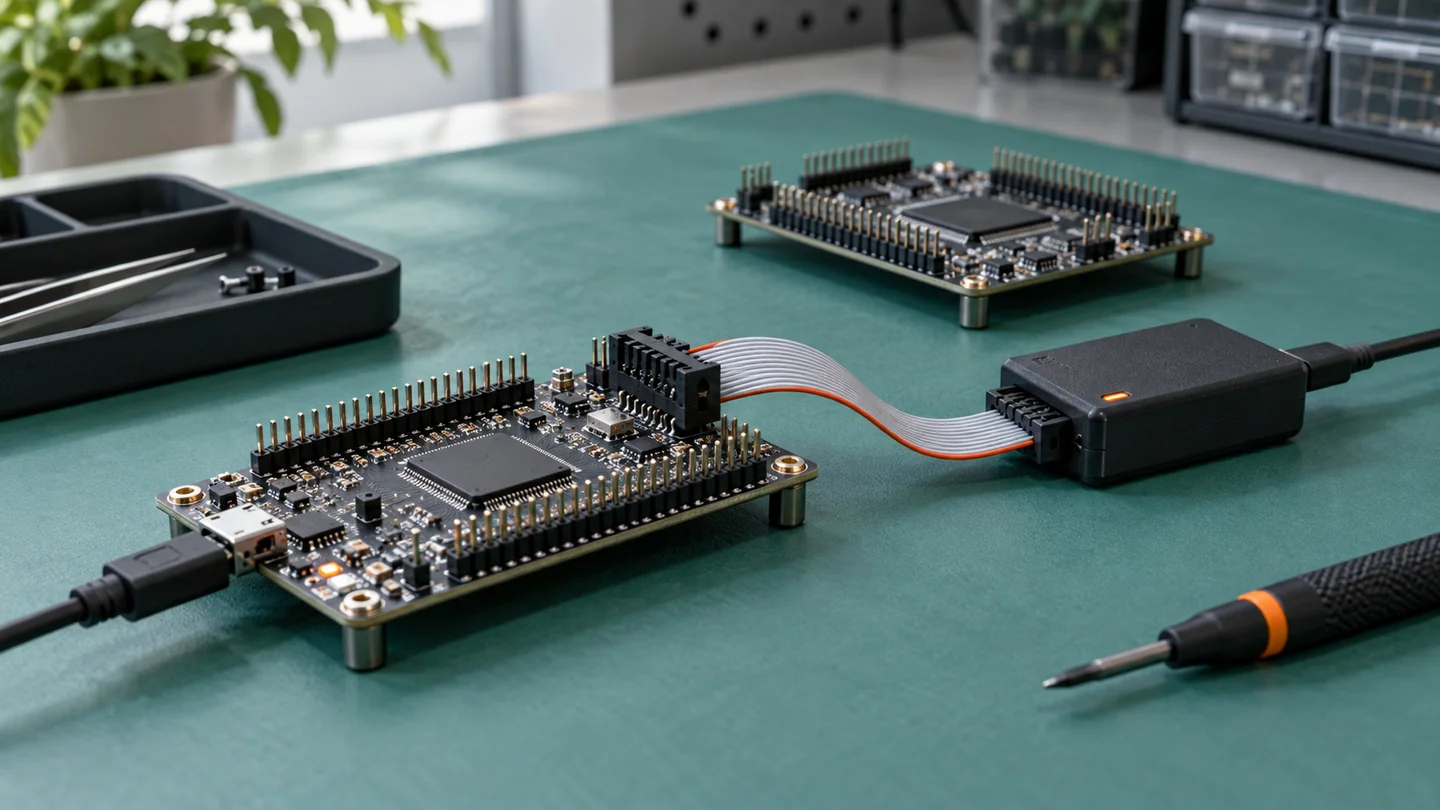
Treat a real-time operating system (RTOS) migration as a controlled product change, not simply a successful rebuild. Your release decision needs evidence that the application still behaves correctly on its actual board, with its actual peripherals, timing constraints and operating modes.
Zephyr 4.4 was announced on 14 April 2026. Its release notes include Zephyr SDK 1.0 support and C17 as the default minimum C standard, alongside networking and developer-tool changes. Those changes make a dependency and regression review useful even when the product is not adopting a headline new feature.
First make the old build reproducible
Before upgrading, rebuild the currently accepted firmware in a clean environment. Preserve the application commit, module revisions, SDK and tool versions, board target, configuration overlays and build command. Keep the generated image and a checksum with the test record. A candidate cannot be compared fairly with an undocumented local build.
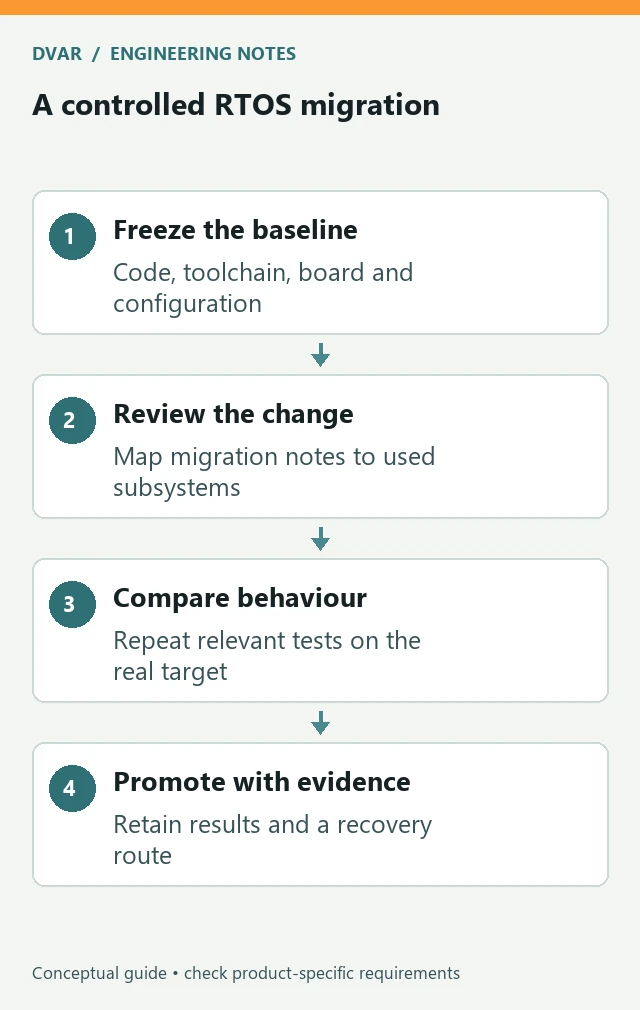
West supports west manifest --freeze, which produces a manifest using commit SHAs for project revisions. Archive that output as part of the baseline. It does not replace preserving your application changes, build environment or external test assets. The West manifest documentation explains the distinction between resolving a manifest and freezing its revisions.
Read the migration guide against your product inventory
Create a short list of the subsystems the product actually uses: board support, drivers, Bluetooth or Wi-Fi, storage, bootloader, security libraries and application services. Review the 4.4 migration guide against that list. Mark each relevant change as requiring a source update, a configuration decision, a test or an explicit not-applicable rationale.
Do not resolve a configuration warning solely by deleting the setting until the build becomes quiet. Determine what behaviour the old setting controlled and whether its replacement changes the intended product configuration. Preserve that reasoning in the change record. It helps a later maintainer distinguish a deliberate decision from an accidental workaround.
Separate build success from behavioural evidence
Use several layers of evidence. Host-side or simulated tests can exercise logic and many software paths; target tests are still needed for board-specific interactions. Zephyr’s Twister documentation describes its test-runner workflow, including test selection and execution options. Choose the coverage appropriate to the product rather than treating a green aggregate result as proof of every physical interface.
For each important function, record the stimulus, expected response, measurement method and acceptance limit. A sensor test should say more than “sensor works”: identify the interface, sample configuration, error paths and what the test checks. Keep the fixture and input data stable when comparing old and candidate firmware, or record why either changed.
Compare timing, memory and failure behaviour
Include boot time, relevant response deadlines, memory use and watchdog behaviour in the comparison where they affect requirements. Exercise communications alongside the application workload, not only in isolation. Record whether logging, assertions and optimisation settings match the intended release configuration. Otherwise a useful development measurement may be mistaken for a production result.
Illustrative acceptance example: if a product requirement allows a response within 50 ms, both the baseline and candidate must be evaluated against that requirement under the specified load. A baseline result of 20 ms does not create permission to accept 55 ms merely because the upgrade adds valuable features. The limit comes from the product requirement; the example values are not Zephyr benchmarks.
Test failure paths deliberately: a disconnected peripheral, malformed input, a storage error and a communication timeout may expose different problems from the normal path. Select fault conditions that are safe for the fixture and relevant to the design. Keep power interruption and firmware-update recovery as their own test plan rather than assuming an RTOS migration test covers them automatically.
A release-ready migration checklist
- The old firmware can be rebuilt from recorded inputs.
- The candidate’s code, SDK, modules and configuration are identified.
- Relevant migration-guide items have an owner and disposition.
- Required functions and error paths have explicit acceptance criteria.
- Target measurements state their load, logging and environmental conditions.
- Unexpected changes in timing or memory are explained, not merely observed.
- Test results link to the exact firmware image and board revision.
- The deployment and recovery decision is approved separately from compilation success.
DVAR’s embedded software development and automated test equipment services bring the firmware change and repeatable target testing into the same engineering discussion. For the update-recovery portion, see our separate power-loss test plan.